


Slip and fall accidents can happen anywhere, from grocery stores to office buildings. These incidents often lead to serious injuries and costly medical bills. If you were hurt due to someone else’s negligence, gathering the right evidence is crucial for proving your case and recovering compensation.
Why evidence is important in slip and fall cases
Evidence serves as the foundation for proving your case after a slip and fall. Without solid documentation and testimony, it becomes very difficult to show how the accident occurred, who was at fault, and how much harm you suffered. Strong evidence strengthens your credibility, helps counter defenses from property owners or insurers, and increases the likelihood of obtaining fair compensation.
Here are key reasons why evidence is essential:
- Establishing negligence: Evidence helps show that the property owner or occupier knew (or should have known) about the dangerous condition and failed to fix or warn about it.
- Proving causation: It connects the hazardous condition to your injury, by showing that the fall was directly caused by that hazard and not by some other factor.
- Demonstrating damages: Medical records, bills, and treatment notes prove the severity of your injuries, the cost of your care, and the impact on your life.
- Supporting your version of events: Witness statements, photos, videos, and incident reports help confirm your account of what happened.
- Countering defenses:When the opposing side argues you were partly at fault or that the condition was obvious, your evidence provides a stronger counter-position.
- Enhancing negotiating strength: Well-documented evidence gives your attorney leverage during settlement talks or in court, making it harder for insurers to lowball or deny your claim.
Types of evidence you need to collect
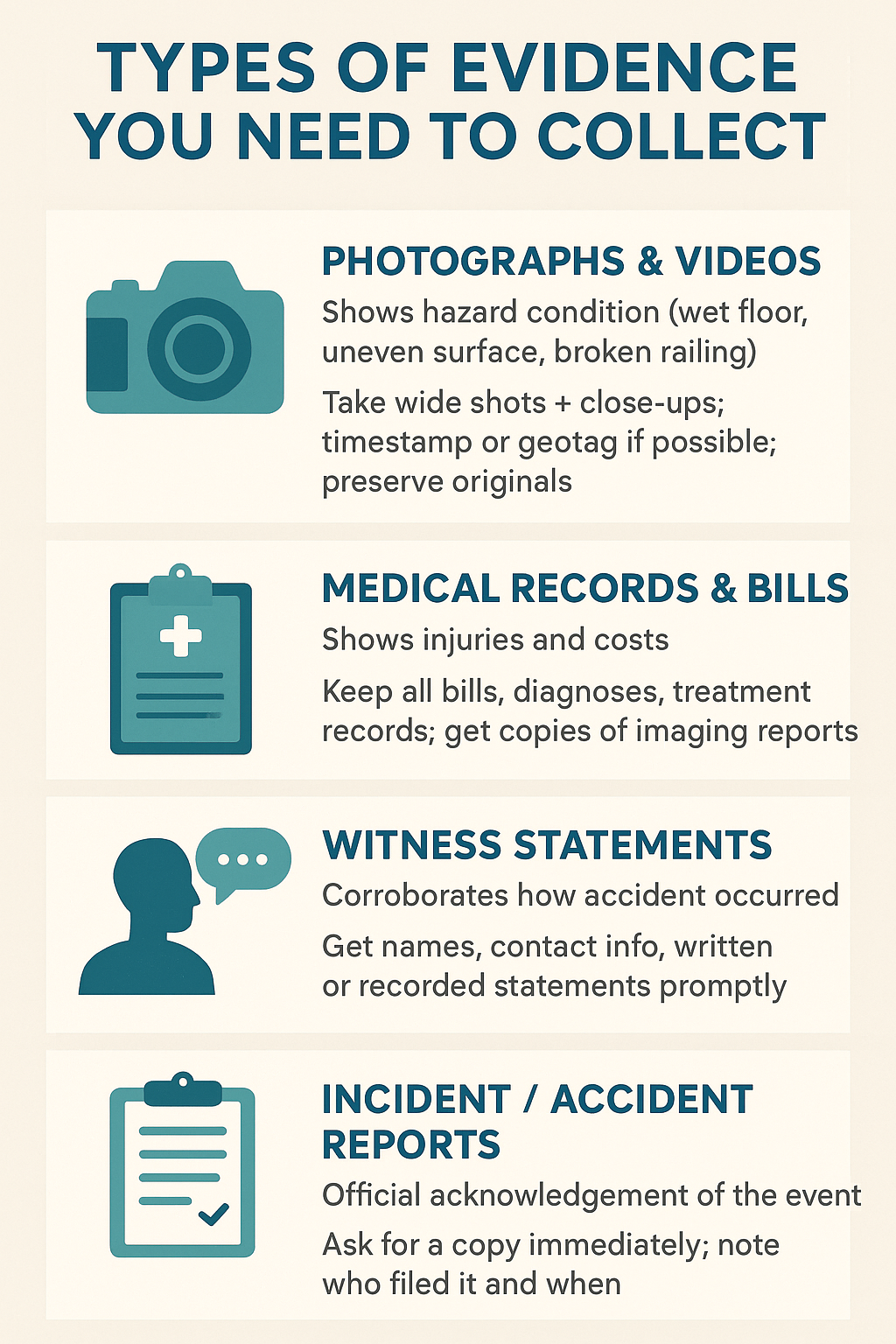
To build a strong slip and fall claim, you will need different types of evidence. Each piece plays a role in showing how the accident happened and why the property owner is liable.
Photographs and videos
Visual proof can clearly show the hazardous condition that caused your fall. Take photos of wet floors, uneven surfaces, or broken railings immediately after the accident. If possible, capture wide shots of the area as well as close-ups of the hazard.
Medical records and bills
Medical documentation connects your injuries directly to the accident. Keep detailed records of doctor visits, hospital stays, prescriptions, and rehabilitation treatments. These records prove the extent of your injuries and the financial impact they have caused.
Witness statements
Eyewitnesses can confirm how the accident occurred and whether dangerous conditions were present. Collect the names and contact information of anyone who saw the fall. Their statements may provide credibility and support your version of events.
Incident reports
If your accident happened in a business or public property, report it immediately to management. Ask for a copy of the incident report, as this document is an official acknowledgment that the accident took place.
Expert testimony
In some cases, experts may be necessary to explain property maintenance issues or reconstruct how the fall occurred. Their professional input can help clarify liability and strengthen your claim.
Next steps: What to do with your evidence
Once you’ve collected photos, medical records, witness contacts, incident reports, and any expert input, it’s crucial to treat that evidence carefully. How you preserve and organize it can make or break your case. Below are the steps you should follow:
Step 1: Preserve the evidence immediately
Keep original items intact and avoid altering or discarding them. Make digital copies or photos of documents, images, and physical items, and store everything securely in a folder or cloud storage.
Step 2: Organize a chronological file
Arrange your evidence by date, starting from the accident through medical treatments and expenses. Label everything clearly and maintain a simple index or spreadsheet to track what each item is.
Step 3: Secure witness statements early
Contact witnesses quickly and ask them to provide written or recorded accounts of what they saw. Make sure statements include names, contact details, and dates, then keep them with your other records.
Step 4: Notify relevant parties and report in writing
File a formal incident report with the property owner or manager and request a copy. Also write your own detailed account of the accident, sign and date it, and keep any related correspondence.
Step 5: Share with your attorney (and only your attorney)
Give all evidence to your lawyer so they can build your case and decide how best to use it. Avoid sharing documents with insurers or online without your attorney’s approval.
Step 6: Monitor and update over time
Continue adding new medical records, bills, and treatment notes as you recover. Keeping your file updated ensures your case reflects the full extent of your injuries.
With Knapp Moss, your slip and fall claim is in capable hands
Recovering from a slip and fall accident is stressful enough without worrying about legal details. The attorneys at Knapp Moss know how to gather, preserve, and present evidence that strengthens your claim. With our experience, you do not have to face insurance companies alone.
Reach out today for a free consultation.
Frequently Asked Questions
Seek medical attention right away, report the accident, and take photos of the scene if possible.
Each state has a statute of limitations, typically ranging from one to three years. It is best to consult an attorney quickly.
Property owners, managers, or businesses responsible for maintaining safe conditions may be held liable.